
Masonry Tool Kit for Renovation Success
To guarantee renovation success, you'll need a thorough masonry tool kit that covers essential hand tools, power tools, and specialized equipment. From trowels and jointers to demolition hammers and rotary hammers, each tool plays a critical role in completing tasks efficiently and effectively. You'll also need mixing and measuring tools, tamping and finishing tools, and safety gear to protect yourself from hazards. Additionally, pointing and grouting tools, cutting and shaping tools, leveling and alignment tools, and cleanup and storage tools are must-haves for a successful project. With the right tools and knowledge, you'll be well-equipped to tackle your masonry renovation project and achieve professional results.
Key Takeaways
• A comprehensive masonry tool kit should include essential hand tools, power tools, mixing and measuring tools, and finishing tools for renovation success.
• Ensure you have the right power tools, such as demolition hammers and rotary hammers, to handle heavy-duty tasks and improve efficiency.
• Mixing and measuring tools, including mixing buckets, measuring cups, and mixing sticks, are crucial for accurate material preparation and consistency.
• Tamping and finishing tools, like tamping tools and finishing trowels, help achieve a professional finish and long-lasting results in masonry work.
• Safety gear and protection, including head, eye, respiratory, foot, and hand protection, are essential to mitigate risks and prevent accidents during renovation tasks.
Essential Hand Tools for Masonry
When tackling a masonry project, having the right essential hand tools at your disposal guarantees a solid foundation for a successful renovation.
You'll need a sturdy trowel for scooping and spreading mortar, allowing you to achieve a smooth, even layer for brick laying. A level and straightedge guarantee your walls are plumb and your courses are straight. A jointer or pointing trowel helps you finish joints and fill gaps with precision.
For mortar mixing, a mixing bucket, hoe, and tamping tool are must-haves. You'll also need a wire brush for cleaning excess mortar from bricks and a rubber mallet for tapping bricks into place.
Don't forget a measuring cup and mixing stick for accurately proportioning your mortar mix. With these essential hand tools, you'll be well-equipped to tackle brick laying and mortar mixing tasks with confidence.
Power Tools for Heavy Lifting
When you're tackling heavy lifting in your masonry renovation, you'll need the right power tools to get the job done efficiently.
You'll likely find yourself relying on demolition hammers and rotary hammers to break up and remove existing structures, so it's crucial to understand the features and benefits of each.
Demolition Hammer Essentials
You'll need a reliable demolition hammer to tackle heavy-duty demolition tasks, such as breaking up concrete, removing tile, and tearing down walls. When choosing a demolition hammer, consider the weight, power, and features that fit your specific needs. A heavier hammer may provide more force, but it can be exhausting to use for extended periods.
| Demolition Technique | Hammer Safety | Recommended Hammer Weight |
|---|---|---|
| Breaking up concrete | Wear safety goggles, gloves, and a dust mask | 15-20 lbs |
| Removing tile | Use a hammer with a chisel attachment, wear steel-toed boots | 10-15 lbs |
| Tearing down walls | Use a hammer with a pointed tip, wear a hard hat and safety glasses | 20-25 lbs |
Remember to always follow proper demolition techniques and hammer safety guidelines to avoid injury. A demolition hammer is a powerful tool, and misuse can lead to serious harm. By choosing the right hammer and following safety protocols, you'll be well on your way to successfully completing your renovation project.
Rotary Hammer Options
By the time you're tackling heavy-lifting tasks like drilling through concrete or breaking up thick tile, a rotary hammer becomes an indispensable power tool in your renovation arsenal. This powerful tool is designed to handle the toughest tasks with ease, making it a must-have for any serious DIY enthusiast or professional.
When it comes to choosing the right rotary hammer for your needs, you've got options. Here are a few to take into account:
-
Cordless rotary hammers: Offering greater flexibility and convenience, these hammers are perfect for working in tight spaces or on-the-go.
-
Hammer drill combos: These versatile tools combine the power of a rotary hammer with the functionality of a drill, making them ideal for a wide range of tasks.
-
High-torque rotary hammers: Designed for heavy-duty applications, these hammers deliver the power and performance you need to tackle even the most demanding tasks.
Whether you're breaking up concrete, drilling through tile, or driving anchors, a rotary hammer is the perfect tool for the job. With the right model in your toolkit, you'll be able to tackle even the toughest tasks with confidence and precision.
Mixing and Measuring Tools
When you're preparing for a masonry renovation, you'll need the right mixing and measuring tools to get the job done efficiently.
You'll want to guarantee you have a reliable mixing bucket that can handle the volume of materials you're working with, as well as a measuring cup that provides accurate readings.
Mixing Bucket Essentials
Assemble an extensive mixing bucket kit with the fundamental mixing and measuring tools necessary to accurately prepare and apply mortar, concrete, and other materials for your renovation project. A well-stocked mixing bucket kit guarantees you're equipped to tackle various mixing tasks, from small repairs to large-scale construction.
When selecting a mixing bucket, consider the size of your project and the type of materials you'll be working with. Buckets come in various sizes, ranging from 2-5 gallons, so choose one that suits your needs. For larger projects, a bigger bucket may be necessary, while smaller buckets are ideal for smaller repairs or areas with limited space.
Here are some essential items to include in your mixing bucket kit:
-
A sturdy, heavy-duty bucket with a non-slip handle and a pouring spout
-
A mixing stick or trowel for efficient mixing and scraping
-
A bucket grid or mixing grid for effective mixing techniques
Measuring Cup Accuracy
To guarantee accurate measurements, invest in a high-quality measuring cup that's specifically designed for mixing and measuring materials.
Look for features such as clear, easy-to-read markings and a sturdy construction that can withstand regular use. This will ascertain you're following precise measuring techniques, adhering to industry-standard measurement standards, and avoiding costly mistakes.
When selecting a measuring cup, choose one made from durable materials, such as stainless steel or heavy-duty plastic.
A cup with graduated markings will allow you to measure materials with precision, and a comfortable handle will make it easy to pour and mix.
Consider a measuring cup with a spout or lip to prevent spills and messes.
Tamping Tool Precision
With accurate measurements in hand, you can now focus on guaranteeing proper material consolidation with a tamping tool that's precision-engineered for ideal results. A high-quality tamping tool is essential for achieving the perfect mix, as it helps to eliminate air pockets and guarantees that the materials are evenly distributed.
When it comes to tamping techniques, you'll want to use a consistent, gentle pressure to avoid over- or under-tamping. This will help you achieve the perfect balance of strength and workability in your materials.
Here are some key considerations for selecting the right tamping tool for your project:
-
Material selection: Choose a tamping tool made from durable, high-quality materials that can withstand heavy use.
-
Tamping head design: Opt for a tamping tool with a head design that's specifically engineered for your tamping materials, guaranteeing maximum efficiency and effectiveness.
-
Ergonomic handle: Select a tamping tool with an ergonomic handle that provides a comfortable grip, reducing fatigue and improving control.
Tamping and Finishing Tools
You'll need a tamping tool to consolidate and level freshly laid mortar, guaranteeing a solid bond between masonry units. Mastering tamping techniques is essential to achieve a professional finish. A tamping tool helps to remove excess mortar, compact the mixture, and create a level surface. This process guarantees that the masonry units are properly aligned and securely bonded.
In addition to a tamping tool, you'll require finishing tools to add the final touches to your masonry project. A jointer or joint raker is necessary for creating uniform joints and removing excess mortar. A pointing trowel is used to fill and smooth out joints, while a finishing trowel helps to create a smooth, even surface.
These tools will enable you to add the finishing touches to your project, guaranteeing a professional-looking result. By using the right tamping and finishing tools, you'll be able to achieve a high-quality finish that will last for years to come. With these tools in your masonry tool kit, you'll be well-equipped to tackle any renovation project with confidence.
Safety Gear and Protection
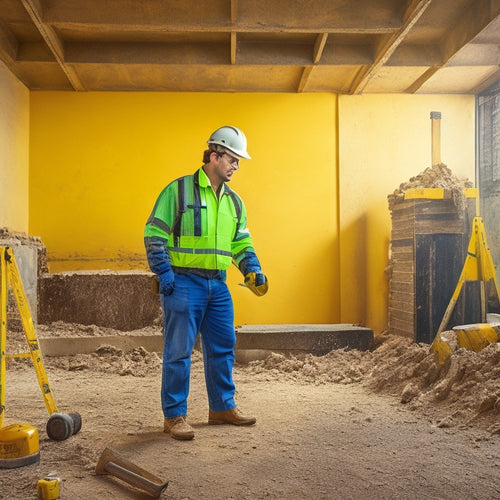
Your safety gear and protection equipment are vital components of your masonry tool kit, as they safeguard you from the hazards associated with renovation projects.
As you take on renovation tasks, you're exposed to various risks, including falling objects, electrical shock, and respiratory problems. That's why it's important to prioritize your safety above all else.
To guarantee your well-being, make sure you have the following safety essentials in your kit:
-
Hard hat and safety glasses: protect your head and eyes from debris and falling objects
-
Dust mask and respirator: prevent inhalation of harmful dust and particles
-
Steel-toed boots and gloves: shield your feet and hands from heavy objects and sharp edges
Pointing and Grouting Tools
Pointing and grouting tools are essential for refilling and repairing joints between masonry units, ensuring a structurally sound and visually appealing renovation outcome. You'll need the right tools to master various pointing techniques, from raking out old mortar to repointing and finishing joints. For grouting, you'll require a range of materials, including cement-based, epoxy-based, and acrylic-based grouts, each suited to specific applications.
When selecting grouting materials, consider factors like color, durability, and workability. Here's a brief comparison of popular grouting materials:
| Grouting Material | Color Flexibility | Durability |
|---|---|---|
| Cement-based | Limited | High |
| Epoxy-based | High | Very High |
| Acrylic-based | Medium | Medium |
Cutting and Shaping Tools
With the pointing and grouting process complete, turn your attention to cutting and shaping masonry units to fit around obstructions, make repairs, or create custom designs. This stage requires precision and the right tools to achieve professional results.
As you explore cutting and shaping, you'll need to make precise cuts in tiles, stones, and other masonry materials.
To get started, you'll need the following essential tools:
-
Tile cutting nippers: for cutting curved or irregular shapes in tiles
-
Stone shaping chisels: for shaping and refinishing stone surfaces
-
Masonry saws: for making straight cuts in tiles, stones, and bricks
These cutting and shaping tools will allow you to customize your masonry project with ease. Whether you're creating an intricate tile design or repairing a damaged stone wall, having the right tools will give you the freedom to bring your vision to life.
With these tools in your arsenal, you'll be able to tackle even the most complex cutting and shaping tasks with confidence.
Leveling and Alignment Tools
You'll next need to confirm your masonry units are properly aligned and level, as even slight deviations can compromise the structural integrity of your project. To achieve this, you'll require a range of leveling and alignment tools.
Start with a spirit level, which ensures your units are perfectly horizontal or vertical. For more precise measurements, use a laser level to project a level line or plane across your work surface. This is particularly useful for large-scale projects or when working with complex angles.
In addition to leveling techniques, you'll need alignment methods to confirm your units are properly positioned. A string line, for instance, helps you establish a straight line or reference point for your masonry work. You can also use a combination square to check and adjust the alignment of your units.
Don't forget a torpedo level, which is designed for tight spaces and can help you level units in confined areas. By incorporating these leveling and alignment tools into your masonry kit, you'll be able to achieve professional-grade results with confidence and precision.
Cleanup and Storage Tools
Take control of your workspace by incorporating essential cleanup and storage tools into your masonry kit to maintain a safe and organized environment throughout the renovation process. Efficient cleanup strategies and storage solutions are vital to a successful project, allowing you to focus on the task at hand without unnecessary distractions.
To guarantee a clutter-free workspace, consider adding the following tools to your kit:
-
A sturdy wheelbarrow or dustpan for quickly removing debris and dust
-
A set of storage bins and containers to keep small items organized and within reach
-
A cordless vacuum or blower to easily clean up dust and dirt from surfaces and crevices
Frequently Asked Questions
How Often Should I Clean and Maintain My Masonry Tools?
You should clean your tools daily, and perform deep maintenance weekly, to prevent rust and wear. Establish a tool cleaning frequency and adhere to maintenance best practices to guarantee your tools remain in top condition.
Can I Use Masonry Tools for Other Construction Projects?
'Channel your inner Renaissance master builder - you can indeed repurpose masonry tools for other construction projects, leveraging their versatility in alternative applications like tile setting, concrete finishing, or even sculpting, unfastening new creative freedoms.'
Are Masonry Tools Suitable for DIY Home Renovations?
When tackling DIY home renovations, you'll find masonry tools suitable for various tasks; their benefits lie in versatility and precision, so follow expert DIY renovation tips to access their full potential and achieve professional-looking results.
What Is the Average Cost of a Basic Masonry Tool Kit?
You're probably wondering, what's the damage going to be? A basic masonry tool kit can cost anywhere from $200 to $500, depending on the tool kit essentials you need and your budget considerations.
Can I Rent Masonry Tools Instead of Buying Them?
You can opt for rental advantages, gaining tool accessibility without the upfront cost, and still achieve your renovation goals; many equipment rental shops offer masonry tools, giving you the freedom to focus on your project.
Conclusion
You've got the right tools for a successful masonry renovation.
With a well-stocked kit, you'll tackle projects efficiently and effectively.
Did you know that according to the National Association of the Remodeling Industry, a staggering 85% of homeowners undertake a major renovation project within the first five years of ownership?
With your new toolkit, you'll be well-prepared to tackle any masonry task that comes your way, ensuring a beautiful and long-lasting result.
Related Posts
-

Streamlining Your Exterior Renovation Timeline
To streamline your exterior renovation timeline, start by identifying your project goals and objectives, and prioriti...
-
5 Vital Safety Tips for DIY Renovation Success
When tackling a DIY renovation, you'll need to prioritize safety above all else. Start by protecting yourself from fl...
-
7 Best Plastering Bat Sizes for DIY Renovations
When tackling DIY renovations, you'll want to choose the right plastering bat size to achieve a professional-looking ...
