
Concrete Tool Buying Checklist for Home Renovation
When buying concrete tools for your home renovation project, verify you cover the essential categories: mixing, surface preparation, finishing, safety, and measuring/testing tools. Additionally, consider brick and concrete wall tools, hand tools, power tool requirements, and specialized finishing tools. Don't forget tool storage solutions and safety equipment to protect yourself and your investment. As you traverse the world of concrete tools, prioritize tasks, materials, and project demands to guarantee the right tools for the job. By understanding these key areas, you'll be well on your way to achieving a successful and structurally sound project that meets your vision.
Key Takeaways
- Identify the specific tasks and surfaces in your renovation project to choose the right concrete tools for the job.
- Consider the four primary concrete tool categories: mixing, surface preparation, finishing, and safety tools.
- Select power tools based on drilling and cutting considerations, motor power evaluation, and tool compatibility.
- Ensure you have the necessary measuring and testing tools, such as levels, squares, and concrete test hammers, for a successful project.
- Don't forget to invest in essential safety equipment, including personal protective equipment (PPE) and ventilation and dust control measures.
Essential Concrete Tool Categories
Most concrete projects require a well-rounded set of tools to achieve professional results, and categorizing them can help you prioritize your purchases.
You'll need tools for concrete mixing, including a mixing bucket, a mixing drill, and a mixing paddle. These tools will assist you in achieving the right consistency for your concrete.
For surface preparation, you'll need tools like a scraper, a broom, and a pressure washer to clean and prepare the area for concrete application.
Other essential categories include finishing tools, like trowels, edgers, and floats, which help you attain a smooth, even finish.
You'll also need safety tools, such as gloves, safety glasses, and a dust mask, to protect yourself from the hazards of working with concrete.
Additionally, measuring and testing tools, like levels, squares, and concrete test hammers, will guarantee that your project meets specifications and is structurally sound.
Brick and Concrete Wall Tools
Precision is key when working with brick and concrete walls, and having the right tools can make all the difference in achieving a sturdy, well-constructed structure.
When it comes to brick laying, you'll need a level, trowel, and jointer to guarantee accurate and uniform placement. A spirit level helps you achieve perfectly horizontal and vertical lines, while a trowel is used to apply and smooth out mortar between bricks. A jointer, on the other hand, is used to finish and smooth out joints.
For wall reinforcement, you'll need tools like wire cutters, wire strippers, and a rebar bender. Wire cutters and strippers are used to cut and prepare reinforcement wire, while a rebar bender is used to shape and bend rebar into the desired form.
Additionally, you may need a concrete mixer, a wheelbarrow, and a shovel to prepare and transport concrete. Having these essential tools on hand will guarantee that your brick and concrete walls are built to last.
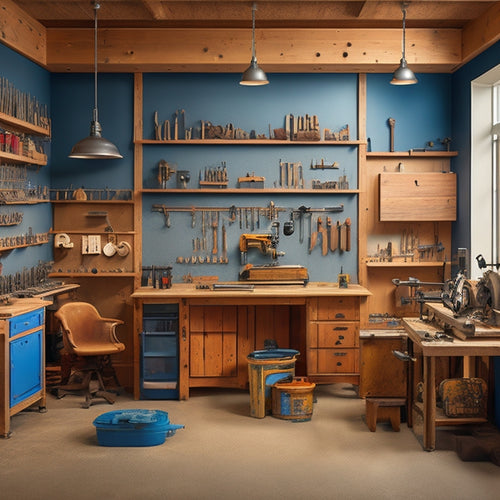
Tool Storage Solutions Considered
Your toolbox is filled with an array of essential tools for brick and concrete wall construction, but without a proper storage system, these investments can quickly become disorganized and even damaged.
Proper tool organization is vital to maintaining efficiency and extending the lifespan of your tools. You'll want to evaluate storage solutions that cater to your specific tool collection, considering the size, shape, and frequency of use.
Tool chests, cabinets, and chests with drawers are popular storage solutions for concrete and brick tools. Look for units with sturdy construction, rust-resistant materials, and adjustable compartments to accommodate your tools.
You may also explore portable storage options like toolboxes, bags, or pouches for on-site storage and transportation. When selecting a storage solution, assess the weight capacity, mobility, and security features to guarantee your tools are protected from theft or loss.
Effective tool organization will save you time and frustration, allowing you to focus on completing your home renovation project efficiently.
Hand Tools for Concrete Work
You'll need trowels and edgers to shape and smooth concrete surfaces, ensuring a professional finish.
Concrete finishing tools, such as float blades and finishing trowels, are also essential for achieving the desired texture and appearance.
As you select hand tools for concrete work, consider the specific tasks and surfaces you'll be working with to choose the right tools for the job.
Trowels and Edgers
Concrete work relies heavily on the right hand tools, and trowels and edgers are essential components of this arsenal. You'll need them to shape, smooth, and finish your concrete surfaces.
When it comes to trowels, you'll encounter various types, each designed for specific tasks. The most common are finishing trowels, used for smoothing and finishing concrete surfaces, and notched trowels, ideal for applying and spreading materials like adhesive or epoxy. You may also come across pointing trowels, which are perfect for small, intricate work.
Edgers, on the other hand, are used to create clean, defined edges and joints. You'll find edger designs that cater to different concrete types and applications. For instance, edgers with rounded edges are suitable for curved or rounded surfaces, while those with square edges are better for creating sharp, defined joints.
Some edgers also come with adjustable handles, allowing you to change the angle and direction of the blade. As you select your trowels and edgers, consider the specific requirements of your project, including the type of concrete, surface finish, and desired outcome.
Concrete Finishing Tools
Regularly, hand tools prove indispensable in concrete finishing, as they allow for precision and control when working with small, intricate areas or making final touches to a project.
When it comes to achieving specific surface textures and smoothing techniques, you'll find that hand tools are essential.
Some of the most critical concrete finishing tools to have in your arsenal include:
- Bull floats: used for applying a smooth finish to freshly poured concrete
- Hand floats: ideal for smaller areas and providing a high-gloss finish
- Tamping tools: used to compact and level freshly poured concrete
- Edging tools: designed for creating clean, defined edges and joints
These tools will enable you to achieve the desired surface texture and finish, whether you're working on a patio, driveway, or interior floor.
With the right hand tools, you'll be able to tackle even the most intricate concrete finishing tasks with confidence and precision.
Power Tool Requirements Checklist
When selecting power tools for concrete work, you'll need to contemplate specific criteria to guarantee you're getting the right tools for the job.
You'll need to think about the type of drilling or cutting you'll be doing, as well as the material you'll be working with, to determine the appropriate drill bit requirements.
Additionally, you'll want to evaluate motor power options to make certain you have the necessary torque and speed to get the job done efficiently.
Tool Selection Criteria
By the time you're ready to invest in concrete tools, you've likely given some thought to the type of projects you'll be tackling and the frequency of use.
This will help you determine the right tool selection criteria for your needs. Consider the following factors to guarantee you get the most out of your tools:
-
Tool compatibility: Will your new tools work seamlessly with your existing equipment and accessories?
-
Power source: Do you prefer cordless or corded tools, and what're the implications for your work site and power availability?
-
Ergonomics and comfort: Will the tool's design and weight reduce fatigue and improve your overall working experience?
- Maintenance tips: Are the tools easy to clean and maintain, and what're the recommended servicing schedules?
Drill Bit Requirements
Your drill bit requirements will depend on the specific tasks you'll be performing and the types of concrete you'll be working with.
For instance, if you'll be drilling into high-strength concrete, you'll need drill bits made from high-quality, heat-resistant materials like tungsten carbide or diamond-coated bits. These materials can withstand the intense heat generated during drilling and provide a longer lifespan.
When it comes to bit types, you'll need to take into account the specific task at hand.
For example, twist bits are ideal for drilling small holes for anchors or screws, while step bits are better suited for drilling larger holes for pipes or conduit. You may also need specialized bits like masonry bits or hammer bits for specific applications.
It's also crucial to take into account the shank type and size, as this will affect the compatibility of your drill bits with your drill.
Make certain to choose bits with a shank size that matches your drill's chuck size.
Motor Power Options
How much power do you need to drive your concrete tools efficiently? When it comes to motor power options, you have several choices. Understanding the different motor types and power ratings is essential to guarantee you get the right tool for your project.
-
Brushed motors: These motors are economical and suitable for low-to-medium duty applications. They're often found in drills and drivers.
-
Brushless motors: These motors are more efficient, reliable, and durable than brushed motors. They're ideal for high-torque applications like hammer drills and impact wrenches.
-
Cordless motors: These motors offer greater convenience and flexibility, making them perfect for remote or hard-to-reach areas.
- High-torque motors: These motors are designed for heavy-duty applications, such as breaking up concrete or drilling through thick materials.
When selecting a motor, consider the power rating, which is typically measured in amps (A) or watts (W). A higher power rating generally means more power and speed.
However, it also increases the tool's weight, size, and cost. Choose a motor that balances power with your specific needs and preferences.
Safety Equipment for Concrete Work
When working with concrete, you're exposed to a multitude of hazards, from airborne silica dust to heavy machinery and sharp edges. It's essential to prioritize safety equipment to guarantee your well-being on the job site.
First and foremost, invest in personal protective equipment (PPE) that covers you from head to toe. This includes hard hats, safety glasses, earplugs, dust masks, gloves, and steel-toed boots. Confirm your PPE is certified to meet industry standards, such as OSHA regulations.
Hazard awareness is key; take the time to identify potential risks and develop strategies to mitigate them.
Additionally, consider safety accessories like knee pads, elbow pads, and aprons to prevent skin abrasions and punctures.
Don't overlook the importance of proper ventilation and dust control measures, such as respirators and dust extractors, to minimize the risk of respiratory issues.
Measuring and Testing Tools Needed
Accurate measurements and testing are essential to guarantee the quality and integrity of your concrete project.
You'll need to make certain that your concrete mixture is accurately proportioned, and that the finished product meets the required specifications. To achieve this, you'll require a range of measuring and testing tools.
Some essential tools to include in your arsenal are:
- Laser levels to make certain accurate horizontal and vertical alignment
- Concrete test hammers to determine the compressive strength of your concrete
- pH meters to measure the alkalinity of your concrete mixture
- Measuring cups and scales to accurately proportion your cement, aggregate, and water
Specialized Concrete Finishing Tools
Your concrete project's final appearance and durability rely heavily on the finishing process. Finishing techniques can make or break the overall look and feel of your concrete surface. To achieve the desired surface textures, you'll need specialized concrete finishing tools.
For a smooth, glossy finish, you'll need a power trowel or a ride-on trowel. These tools help to remove excess water and even out the surface.
For a more textured look, consider using a fresno or a bull float. These tools create a rougher surface, perfect for outdoor areas or decorative concrete.
If you're aiming for a specific pattern or design, you may need a stamp or a stamper. These tools allow for intricate designs and patterns to be imprinted onto the concrete surface.
Don't forget to invest in a good edger, which helps to create clean, defined edges and joints.
Frequently Asked Questions
Can I Rent Concrete Tools Instead of Buying Them?
You can rent concrete tools instead of buying them, saving upfront costs; however, calculate the total rental duration and cost to ascertain it's more economical than purchasing, and weigh the convenience of rental against the long-term benefits of tool ownership.
How Do I Clean and Maintain My Concrete Tools?
As you'd polish Excalibur, you'll want to carefully clean your concrete tools after each use, storing them in a dry, protected area; follow maintenance tips like lubricating moving parts and sharpening blades to extend their lifespan.
Are Concrete Tools Compatible With Different Materials?
When working with different materials, you'll find that concrete tools vary in material compatibility, but many are designed for versatility, allowing you to switch between tasks with ease, such as using a hammer drill on concrete, brick, or block.
Can I Use Concrete Tools for DIY Projects Other Than Renovation?
You're wondering if those concrete tools are collecting dust between renovations? Well, you'll be thrilled to uncover they have alternative uses in various DIY project applications, from crafting to landscaping, and even furniture making, waiting to be investigated!
Are There Any Eco-Friendly Concrete Tool Options Available?
When shopping for concrete tools, you'll find eco-friendly options made from sustainable materials, such as recycled steel or bamboo, that align with eco-friendly practices, reducing your environmental footprint while still providing high-quality results.
Conclusion
Now that you've got your concrete tool buying checklist in hand, you're ready to tackle that home renovation project with confidence. According to the National Association of Home Builders, the average homeowner spends around $12,000 on home renovations annually - and with the right tools, you can guarantee a significant chunk of that budget goes towards quality results, not costly mistakes. With this thorough checklist, you'll be well-equipped to handle any concrete task that comes your way.
Related Posts
-

Streamlining Your Exterior Renovation Timeline
To streamline your exterior renovation timeline, start by identifying your project goals and objectives, and prioriti...
-

Why Do Cinder Block Wall Renovations Cost So Much
You're likely surprised by the high cost estimate for your cinder block wall renovation project, but it's driven by s...
-
Renovation Tool Checklist for Smooth Finishes
When tackling a renovation project that requires a smooth finish, you'll need a thorough tool checklist to guarantee ...
