
Block Stucco Renovation Material Buying Checklist
When tackling a block stucco renovation, you'll need to gather essential tools, calculate material quantities, and select the right base coats, finishes, and reinforcement materials. Confirm you have a putty knife, trowel, and joint knife, as well as a mixing bucket, measuring cups, and stucco pump or sprayer. Calculate surface area, considering thickness, waste factor, and application techniques. Choose between traditional, EIFS, or acrylic stucco, and don't forget fiber mesh, anchors, and a compatible finish coat. Additionally, prioritize waterproofing and flashing, and finish with texture application, joint reinforcement, and color selection. As you assemble your materials, you'll uncover more details to master for a sturdy, long-lasting renovation.
Key Takeaways
- Calculate material quantities accurately, considering surface area, material thickness, waste factor, and application techniques.
- Choose the right stucco type, base coat, and finish coat options based on project requirements, climate, and durability considerations.
- Select suitable reinforcement materials, anchors, and waterproofing systems to ensure structural integrity and weather resistance.
- Prepare essential tools, including basic, carrying, surface preparation, safety gear, mixing, and application tools for a successful renovation.
- Consider finishing touches, such as texture application, finish coats, joint reinforcement, and color selection to enhance the building's design and surroundings.
Essential Tools for the Job
When tackling a block stucco renovation, having the right tools at your disposal is critical for a successful project.
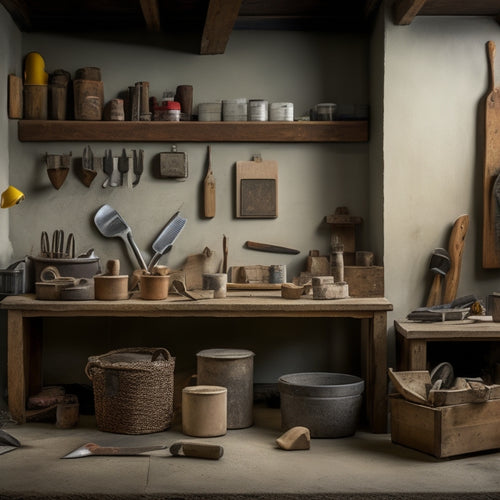
You'll need a range of equipment to guarantee proper surface preparation and stucco application techniques. Start with the basics: a putty knife, trowel, and joint knife for applying and smoothing stucco. A hawk or mortarboard will help you carry and hold stucco mix.
For surface preparation, invest in a wire brush or power washer to remove dirt, grime, and old stucco. A scraper or grinder will help you remove loose or damaged material.
Don't forget safety gear, including gloves, safety glasses, and a dust mask. A mixing bucket, mixing stick, and measuring cups will guarantee accurate stucco mix ratios.
Additionally, consider a stucco pump or sprayer for efficient application, and a level or laser level to guarantee straight lines and even surfaces.
With these essential tools, you'll be well-equipped to tackle your block stucco renovation with confidence.
Stucco Material Quantities Needed
You'll need to accurately calculate the stucco quantity required for your renovation project, considering the surface area to be covered, material thickness, and waste factors.
To guarantee you have enough material, consider measurement factors such as the type of stucco mix, mesh size, and application method.
Stucco Quantity Calculations
How much stucco material will you need to complete your renovation project? To determine this, you'll need to calculate the total square footage of the area to be covered. Measure the length and width of each wall, including any windows, doors, or other obstructions, and multiply them together to get the total square footage.
Don't forget to account for any corners, curves, or irregular shapes that may require additional material.
Next, consider the stucco application techniques and stucco texture styles you plan to use. Will you be applying a smooth finish, or a more textured, decorative finish? This will impact the amount of material needed, as thicker, more textured finishes require more stucco.
A general rule of thumb is to add 10-15% to your total square footage to account for waste and irregularities.
You should also consider the thickness of the stucco layer, which can range from 1/4 inch to 1 inch or more, depending on the desired finish and local building codes.
Material Measurement Factors
The type and quantity of stucco materials needed depend on specific measurement factors. You'll need to take into account the surface area, material types, and installation techniques to guarantee you're buying the right amount of materials for your block stucco renovation project.
To get an accurate calculation, you'll need to measure the surface area of your walls, including any corners, curves, or irregular shapes. You'll also need to decide on the type of stucco material you want to use, such as traditional stucco, EIFS, or acrylic stucco.
Here's a breakdown of the key material measurement factors to contemplate:
| Material Type | Installation Technique | Quantity Calculation Factor |
|---|---|---|
| Traditional Stucco | Hand-applied | 1.25-1.5 sq ft per gallon |
| EIFS | Spray-applied | 1.5-2.0 sq ft per gallon |
| Acrylic Stucco | Roller-applied | 1.0-1.25 sq ft per gallon |
| Fiber Mesh | Used with all material types | 1 roll per 100 sq ft |
Remember to adjust your calculations based on the specific requirements of your project, including the surface area, material type, and installation technique. This will guarantee you have enough materials to complete the job without running out or wasting resources.
Base Coat and Finish Options
You'll need to select a base coat type that suits your stucco renovation project, choosing from options like polymer-modified, fiber-reinforced, or traditional cement-based coatings.
The base coat you choose will influence the finish coat options available to you, which include textured, smooth, or specialty finishes like dash or roughcast.
Base Coat Types
Within the stucco renovation process, selecting the right base coat type is essential for achieving a durable and long-lasting exterior finish.
You'll need to evaluate the specific requirements of your project, including the substrate material, climate, and desired finish.
There are two primary types of base coats: traditional and polymer-modified.
Traditional base coats are made from a mixture of cement, sand, and water, offering a cost-effective solution with moderate weather resistance.
Polymer-modified base coats, on the other hand, incorporate acrylic or polyvinyl acetate (PVA) polymers, enhancing flexibility, water resistance, and adhesion to the substrate.
These advanced base coats are ideal for projects that demand increased durability and crack resistance.
When choosing a base coat, assess the application techniques and drying times.
Traditional base coats typically require a scratch-and-brown application, with drying times ranging from 24 to 48 hours.
Polymer-modified base coats, however, can be applied using a single-layer technique, with faster drying times of 12 to 24 hours.
Understanding these differences will enable you to make an informed decision for your block stucco renovation project.
Finish Coat Options
Selecting the ideal finish coat for your block stucco renovation project is a decisive step, as it directly impacts the final appearance and durability of the exterior finish.
You'll want to evaluate various texture variations, from fine to coarse, to achieve the desired aesthetic. Finish coats can be further customized with color selections, allowing you to match or contrast with surrounding structural elements.
Acrylic-based finish coats offer excellent water resistance and flexibility, making them suitable for regions with high rainfall or extreme temperature fluctuations.
Polymer-modified finish coats, on the other hand, provide enhanced durability and resistance to cracking. You may also opt for an integral color finish coat, which eliminates the need for additional painting or coating applications.
When choosing a finish coat, verify it's compatible with your base coat and meets local building codes and regulations.
Additionally, assess factors such as weather resistance, UV stability, and mold/mildew resistance to guarantee a long-lasting, low-maintenance exterior finish.
Reinforcement and Anchors Required
Reinforcing the block stucco assembly is essential to guaranteeing the structural integrity of the building envelope.
You'll want to choose the right reinforcement types to guarantee that your stucco system can withstand various environmental loads and stresses. The reinforcement materials you select will depend on the specific requirements of your project, including the type of stucco finish, climate, and building codes.
When selecting reinforcement materials, consider the following options:
-
Fiberglass mesh: A popular choice for stucco reinforcement, fiberglass mesh provides excellent strength and durability.
-
Wire mesh: A cost-effective option, wire mesh is suitable for most stucco applications and provides good tensile strength.
-
Polymer-based mesh: A newer reinforcement material, polymer-based mesh offers superior strength and corrosion resistance.
- Galvanized metal mesh: Ideal for high-traffic areas or extreme weather conditions, galvanized metal mesh provides exceptional strength and durability.
In addition to reinforcement materials, you'll also need anchor materials to secure the stucco assembly to the substrate.
Common anchor materials include plastic or metal anchors, screws, and adhesives. Guarantee that your chosen anchor materials are compatible with your stucco system and meet local building codes.
Waterproofing and Flashing Essentials
Most block stucco renovations require a thorough waterproofing and flashing system to prevent water infiltration and guarantee the longevity of the building envelope.
You'll need to verify that your system can withstand harsh weather conditions and prevent moisture from seeping into the walls. To achieve this, you'll need a combination of moisture barriers and flashing techniques.
Start by applying a high-quality moisture barrier to the exterior of the block stucco. This will prevent water from penetrating the surface and reaching the substrate.
Next, focus on flashing techniques around vulnerable areas such as windows, doors, and joints. Use a durable flashing material that can withstand UV exposure and extreme temperatures.
Don't forget to include flashing details at changes between different materials, such as where the block stucco meets the roofing or adjacent walls. A well-designed flashing system will direct water away from the building envelope, reducing the risk of water damage and structural compromise.
Finishing Touches and Accessories
With a reliable waterproofing and flashing system in place, you're ready to focus on the finer details that will complete your block stucco renovation.
Now it's time to think about the finishing touches and accessories that will bring your project to life.
When it comes to texture application, you'll need to decide on the type of finish you want to achieve. This will depend on your personal preference and the style of your building.
Take into account the following essential accessories:
- Texture sprayers: For a uniform, high-quality finish.
- Finish coats: To add color and protection to your stucco surface.
- Joint reinforcement: To add strength and durability to your stucco joints.
- Exterior caulk: To seal gaps and provide a watertight seal.
In addition to these accessories, don't forget to think about color selection.
Choose a color that complements your building's design and surroundings.
With the right finishing touches and accessories, you'll be able to achieve a professional-looking finish that will enhance the beauty and value of your property.
Frequently Asked Questions
Can I Reuse Old Stucco Mix for My Renovation Project?
When renovating, you're likely wondering if you can reuse old stucco mix; however, its properties degrade over time, affecting its suitability. Before reusing, assess the mix's condition, checking for lumps, discoloration, and moisture absorption to verify it still meets your project's requirements.
How Do I Ensure Color Consistency Across Different Material Batches?
To guarantee color consistency, you'll want to excel in color matching techniques, such as spectrophotometric analysis, and implement batch testing methods, like producing sample panels, to secure a seamless blend across different material batches.
Are There Any Eco-Friendly Stucco Material Options Available?
Did you know that the construction industry accounts for nearly 40% of global energy consumption? When shopping for stucco materials, you'll find sustainable materials like recycled aggregate, low-carbon cement, and natural fibers offering green alternatives for a more eco-friendly renovation.
Can I Install Stucco Over Existing Siding or Brick?
You'll need to remove existing siding or prepare brick surfaces before stucco installation; expert siding removal techniques and follow stucco installation tips to guarantee a strong bond, then apply a bonding agent and a scratch coat for a successful makeover.
Do I Need a Permit for a Stucco Renovation Project?
You're likely aware that 80% of renovation projects exceed their initial budget; don't let permit costs surprise you. For a stucco renovation, you'll need permits, which vary by location and type, adding 10-20% to your overall renovation costs, so factor them in to maintain your freedom from financial stress.
Conclusion
You've got all the blocks in place to kick-start your stucco renovation project. Now, it's time to "get down to brass tacks" and turn your vision into a reality. With this thorough checklist, you're well-equipped to tackle the job like a pro. Remember, precision and attention to detail are key to achieving a durable, long-lasting finish. Stay focused, and you'll be enjoying your newly renovated space in no time.
Related Posts
-

Smart Guide to Buying Second-Hand Renovation Tools
When buying second-hand renovation tools, you'll want to set clear renovation goals and a realistic budget to priorit...
-

Why Delay Your Renovation With Poor Tool Management
You're likely unaware that poor tool management is a leading cause of renovation delays, and it's not just about havi...
-
3 Beginner-Friendly Tools for Plaster Renovation Success
You'll be glad to know that the three essential tools you need for a successful plaster renovation are the same ones ...
